Isobel’s maternal support for Gulliver
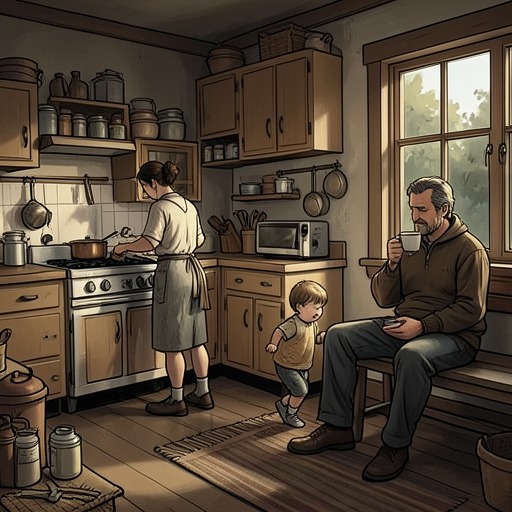
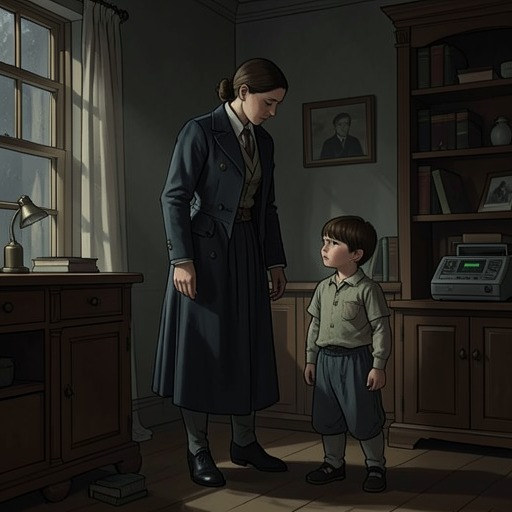
The HumansIsobel Martin’s maternal support for Gulliver Martin is persistent but often meets a closed door: she watches for signs of distress, asks what has happened, and tries to protect him, even as his silences and secrecy limit what she can do. Their relationship moves from immediate care for a bruised, withdrawn teenager to a crisis over his safety, then into a family bond altered by the Alien narrator’s departure and recalled through Gulliver’s later acknowledgment of who cared for them.
Vigilance and withdrawal
When the Alien narrator encounters Gulliver walking alone along a residential road beside the park, the boy is meant to be at school. He tries to hide behind his hair; on seeing the narrator, he freezes and turns away. This sight establishes a gap between the outward routine expected of him and the private distress that Isobel is trying to understand. She does not witness this first encounter, and the narrator does not immediately tell her that Gulliver has been missing school.
The concealed absences become harder to ignore when Gulliver comes home with a bruised eye. Isobel asks repeatedly what happened, but receives no satisfactory answer. He shuts himself in the small utility room behind the kitchen. When he finally opens the door and demands to be left alone, Isobel grants his wish and lets him go upstairs rather than force the conversation. Her response respects his stated boundary, but leaves her with unanswered questions. She says she will phone the school the next day; the narrator, who knows Gulliver has not been attending, says nothing. His silence withholds information Isobel needs in order to understand what is happening.
A crisis of safety
Isobel’s concern becomes acute when Gulliver goes onto the roof in a suicidal crisis. The narrator finds him sitting by the gutter rail, knees drawn to his chest, and begins to see him not as an abstract physical entity but as a person to whom he feels connected. On the roof, Gulliver recalls swimming with the narrator when he was eight and a night in France when he was taught to play dominoes. The memory reaches toward a shared past and tests whether the narrator can recognize it. He answers that he remembers, though the moment carries the strain of a bond that has not been reliably present for Gulliver.
Afterward, Isobel explains that the decision about whether Gulliver would remain in hospital had been hers. She had judged that he would be more at risk inside than outside and agreed that the family would watch him; the hospital had warned that another attempt would leave no choice but admission and observation. Her decision is not a dismissal of the danger but an effort to weigh it against what she believes the hospital might do to him. Gulliver later tells the narrator that, before going onto the roof, he had taken twenty-eight diazepam. The disclosure makes clear that the crisis involved preparation as well as the visible rooftop danger, and that Isobel’s watchfulness could not by itself reveal everything he had concealed.
What Gulliver says, and what Isobel fears
When Gulliver eventually explains himself, he describes the burden of being Andrew Martin’s son. His teachers have read his father’s books and regard him through that reputation, as a failed offshoot of a celebrated family: the expelled schoolboy who set things on fire and whose parents gave up on him. He also remembers his father’s absence during holidays and the tension between his parents, and says they should have divorced years earlier. His account makes his distress relational as well as personal: he feels measured against his father and caught inside a household whose strain he has watched for years.
Isobel’s worry has its own history. She recalls Gulliver’s expulsion as something he wanted, calling it a kind of academic suicide, and remembers that his nursery report said he had resisted making attachments. Although he has had friends, she has long feared his difficulty connecting with people and wonders whether he is anchored to the world and to life. Her fear is sharpened by the resemblance she sees between him and her brother Angus, who died by suicide in his early thirties after financial worries. This family memory gives her present anxiety a specific history; she is not only reacting to one frightening episode but also confronting a loss that makes Gulliver’s withdrawal feel ominous.
When Isobel learns that Gulliver has been walking around instead of attending school, her immediate question is what he has been doing. The narrator can offer only that he does not know. The exchange reveals the cost of the information he withheld: Isobel is left trying to interpret a pattern without knowing its ordinary details, just as Gulliver has been carrying experiences he has not shared with her. Her care is substantial, but neither maternal attention nor concern gives her complete access to her son’s private life.
Separation and a tentative invitation
The family bond is later fractured by the revelation that the man Isobel knew as her husband was not Andrew Martin (original), but the Alien narrator, who had taken his place. After learning that her husband is dead and that the person before her is an alien, Isobel cannot absorb the loss of both the familiar family story and the reality she had trusted. She seeks tablets from a doctor; they do not help, and she spends three weeks in bed with exhaustion. The narrator understands her condition as grief for her husband and for a world that had made sense. Her hostility toward him follows from the deception and from the fact that she had cared for and slept with him without knowing who he was, despite his claim that he had fallen in love with her and that his defiance had saved her and Gulliver.
Years later, the narrator asks Gulliver how Isobel is. Gulliver says that she misses the narrator, distinguishing him from his father: he is the one who looked after them. When the narrator says he thinks Isobel may want him to return, Gulliver confirms the possibility while admitting that she has not said so directly. The narrator hesitates, aware that Isobel might misunderstand his return and that calling him Andrew would be wrong because he has no name. His question about whether she really misses him leaves the invitation unresolved. The exchange nevertheless records a lasting consequence of his place in their household: for Gulliver, care has become a more defining measure of kinship than the identity the narrator impersonated.